Monday, November 1, 2010

Jesus Christ

Jesus Christ - Profile of Jesus Christ from the New Testament:
Jesus of Nazareth, he is the Christ, the "Anointed One," or the "Messiah." The name "Jesus" is derived from the Hebrew-Aramaic word "Yeshua," meaning "Yahweh [the Lord] is salvation." The name "Christ" is actually a title for Jesus. It comes from the Greek word "Christos," meaning "the Anointed One," or "Messiah" in Hebrew.
Jesus is the central figure in Christianity and his life, message and ministry are chronicled in the four Gospels of the New Testament.
Most Bible scholars agree that he was a Jewish teacher from Galilee who performed many miracles of healing and deliverance. He called twelve Jewish men to follow him, working closely with them to train and prepare them to carry on the ministry.
He was crucified in Jerusalem by order of Pontius Pilate, the Roman governor, for claiming to be the King of the Jews. He resurrected three days after his death, appeared to his disciples and then ascended into heaven.
His life and death provided the atoning sacrifice for the sins of the world. Man was separated from God through Adam's sin, but reconciled back to God through Jesus' sacrifice. He will claim his Bride, the church, and later return at his Second Coming to judge the world and establish his eternal kingdom, thus fulfilling Messianic prophecy.
Jesus Christ's Accomplishments:
Jesus Christ's accomplishments are too numerous to list. He was conceived of the Holy Spirit, born of a virgin. He lived a sinless life. He turned water into wine, healed many sick, blind and lame people, he forgave sins, he multiplied fish and loaves of bread to feed thousands on more than one occasion, he delivered the demon possessed, he walked on water, he calmed the stormy sea, he raised children and adults from death to life. He proclaimed the good news of the Kingdom of God.
He laid down his life and was crucified. He descended into hell and took the keys of death and hell. He resurrected from the dead. He paid for the sins of the world and purchased the pardon of men. He restored man's fellowship with God, opening the way to eternal life. These are just a few of his extraordinary accomplishments.
Jesus Christ's Strengths:
Though difficult to understand, the Bible teaches, and most Christians believe that Jesus is God, or Immanuel, "God with us." For more information about Christ's divinity, visit this study of the doctrine of the trinity. Jesus has always existed and has always been God (John 8:58 and 10:30).
Jesus Christ's Weaknesses:
Also difficult to understand, yet the Bible teaches, and most Christians believe, that Jesus was not only fully God, but fully man. He became a human being so that he could identify with our weaknesses and struggles, and most importantly so that he could give his life to pay the penalty for our sins (John 1:1,14; Hebrews 2:17; Philippians 2:5-11).
Check out this resource for more information about why Jesus had to die.
Life Lessons:
Once again, the lessons from Jesus Christ's life are too numerous to list. Love for mankind, sacrifice, humility, purity, servanthood, obedience and devotion to God are some of the most important lessons that his life exemplified.

Hometown:

Jesus was born in Bethlehem of Judea and grew up in Nazareth in Galilee.

Referenced in the Bible:

Jesus is mentioned more than 1200 times in the New Testament. His life, message and ministry are recorded in the four gospels of the New Testament: Matthew, Mark, Luke and John.

Occupation:

Jesus' earthly father, Joseph, was a carpenter, or skilled craftsman by trade. Most likely, Jesus worked alongside his father Joseph as a carpenter. In the book of Mark, chapter 6, verse 3, Jesus is referred to as a carpenter.

Family Tree:

Earthly Father: Joseph
Mother: Mary
Brothers: James, Joseph, Judas and Simon (Mark 3:31 and 6:3; Matthew 12:46 and 13:55; Luke 8:19).
Sisters: Not named but mentioned in Matthew 13:55-56 and Mark 6:3.
The Genealogy of Jesus: Matthew 1:1-17; Luke 3:23-37.

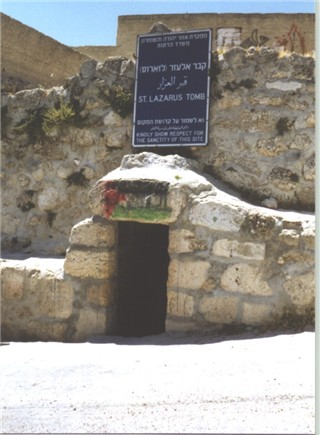
Wednesday, October 27, 2010

What Did Lazarus See?


Think about this scene. One of your best friends has died. Inconsolable, you cry not only at his funeral, but for days afterward.

Then another friend of the deceased comes to visit. He starts saying strange things. You listen to him intently, because your friends' sisters have great respect for him, but you can't grasp what he means.

Finally, he commands that the grave be opened. The sisters protest, but the man is adamant. He prays loudly, looking up to heaven, then after several seconds, your dead friend walks out of his grave--alive!

If you're not familiar with the raising of Lazarus, you'll find this episode described in great detail in the 11th Chapter of the Gospel of John. But what isn't recorded seems equally as baffling. Nowhere in Scripture do we learn what Lazarus saw after he died. If you knew him, wouldn't you have asked him? Wouldn't you want to know what happens after your heart beats for the last time? Wouldn't you pester your friend until he told you everything he saw?
The Plot to Kill a Dead Man
Lazarus is mentioned again in John 12:10-12: "So the chief priests made plans to kill Lazarus as well, for on account of him many of the Jews were going over to Jesus and putting their faith in him." (NIV)

Whether Lazarus told his neighbors about heaven is only speculation. Perhaps Jesus commanded him to be silent about it. The fact remained, however, that he had been dead and now was alive again.

Lazarus' very presence--walking, talking, laughing, eating and drinking, embracing his family—was a cold slap in the face to the chief priests and elders. How could they credibly deny that Jesus of Nazareth was the Messiah when he had raised a man from the dead?

They had to do something. They couldn't dismiss this event as a magician's trick The man had been dead and in his tomb four days. Everyone in the tiny village of Bethany had seen this miracle with their own eyes and the whole countryside was buzzing about it.

Did the chief priests follow through with their plans to kill Lazarus? The Bible doesn't tell us what happened to him after Jesus' crucifixion. He's never mentioned again.
Right From the Source
Surprisingly, we don't find many hard facts about heaven in the Bible. Many of Jesus' teachings about it are in metaphors or parables. We do find a description of the heavenly city in the book of Revelation, yet there isn't much detail on what the saved will be doing there, besides praising God.

Considering that heaven is the goal of every Christian and many non-Christians as well, this lack of information seems like a serious omission.

We're curious. We want to know what to expect. Deep within every human being is the desire to find answers, to break this final mystery.

Those of us who have suffered the disappointment and heartache of this world look forward to heaven as a place where there is no pain, no hurt, and no tears. We hope for a home of endless joy, love, and communion with God.
The Most Important Truth About Heaven
In the end, our human minds are probably incapable of grasping the beauty and perfection of heaven. Maybe that's why the Bible doesn't record what Lazarus saw. Mere words could never do justice to the real thing.

Even if God doesn't disclose all the facts about heaven, he does make perfectly clear what we need to do to get there: We must be born again.

The most important truth about heaven in the story of Lazarus is not what he had to say afterward. It's what Jesus said before he raised Lazarus from the dead:

    "I am the resurrection and the life. He who believes in me will live even though he dies; and whoever lives and believes in me will never die. Do you believe this?" (John 11:25-26 NIV)

Seal of the City of David

Archaeology - Recent Discoveries

Seal of the City of David
Biblical archaeology; recent discoveries - Seal of the City of David


“Now Shephatiah the son of Mattan, Gedaliah the son of Pashhur, Jucal the son of Shelemiah, and Pashhur the son of Malchiah heard the words that Jeremiah had spoken to all the people, saying,

“Thus says the Lord: ‘He Who remains in this city shall die by the sword, by famine, and by pestilence; but he who goes over to the Chaldeans shall live; his life shall be as a prize to him, and he shall live.’ Thus says the Lord: ‘This city shall surely be given into the hand of the king of Babylon’s army, which shall take it.’”

How do we know this passage from Jeremiah 38:1–3 is historically accurate (compare Jeremiah 37:3). First, we can look back at history and see if these words were fulfilled, and secondly, we can look at the archaeological evidence. Excavations have been taking place for quite some time (1920s, ’60s, ’70s and ’80s) in the ancient City of David, located in the lower part of Jerusalem, from where King David once ruled.

The latest excavations are taking place under the experienced hand of Dr. Eilat Mazar, who believes her crew has uncovered the palace of King David. The discovery of a plaque with a seal dating to 580 BC has a name on it that’s close to the names of one of King Zedekiah’s officers.

On the seal is the name “Jucal (also spelled Jehucal), the son of Shelemiah,” the same name that appears in Jeremiah 38:1. This seal dates from before the destruction of the First Temple. These finds, which align with the same time periods in Jeremiah, give historical authenticity to the Bible. They also give archaeologists hope for more discoveries in the palace of the kings of Israel.

These verses in Jeremiah speak of a decree to the Israelites to leave their homeland because God was about to cast them into exile. God would spare the lives of those who left. And He also preserved the decree so the generations that followed would believe that His Word is true! 

New Dead Sea Scroll Fragments

Israel news
The latest discovery;
two small fragments
of animal skin, brown
with age, with Leviticus 23:38-39 and 43-44 inscribed in
ancient Hebrew.
There is only one place on earth where an unending stream of evidence substantiating the Bible
is discovered year after year. Granted, it’s been 40 years since the major discovery of the Dead Sea Scrolls thrilled biblical archaeologists and others who love the Word of God.

The newest Dead Sea Scroll fragments are now in the hands of the Israel Antiquities Authority (IAA). How they got there is an intriguing story in itself. About a year ago, Professor Chanan Eshel, an archaeologist at Bar Ilan University in Tel Aviv, was summoned to an abandoned police station near the Dead Sea for a clandestine meeting with a Bedouin Arab. After explaining that he’d been offered $20,000 on the black market, the man asked Eshel to evaluate the fragments. It would be hard to describe the emotions that surged through the professor’s heart as he examined the skins. “I was jealous that he had found them instead of me,” said Eshel, who has worked in the Judean Desert for nearly 20 years. “I was also very excited, though I didn’t believe I would ever see them again.” Months later, after learning that the fragments had not left the country, Eshel bought them with $3,000 provided by Bar Ilan. The skins were turned over to the IAA, which is now testing them for authenticity. They are the 15th find in this area and date to the Second Revolt against the Romans under Bar-Kochba.

The discovery sparked renewed hope among biblical archaeologists that the Judean Desert has much yet to yield. “No scrolls have been found in the Judean Desert since 1965,” said Eshel. “This [find] encourages scholars to believe that if they bother to excavate, survey and climb, they will still find things in the Judean Desert. The common perception has been that there is nothing left to find there, but that is clearly wrong.”

Arjuna's penance


Mahabalipuram,derived from 'Mamallapuram' is a town in Kancheepuram district in the Indian state of Tamil Nadu. It has an average elevation of 12 metres (39 feet).